Asthma: The Complete Evidence-Based Guide to Understanding, Treating & Managing Your Condition
From wheezing triggers to biologic breakthroughs — master every aspect of asthma care with this clinician-reviewed resource
Asthma affects an estimated 363 million people worldwide and claims approximately 442,000 lives annually. In the US alone, 26.8 million individuals — including 4.5 million children — live with this chronic inflammatory airway disorder. Yet despite its prevalence, asthma remains widely misunderstood.
📑 Navigate This Guide
What Is Asthma? Understanding the Disease
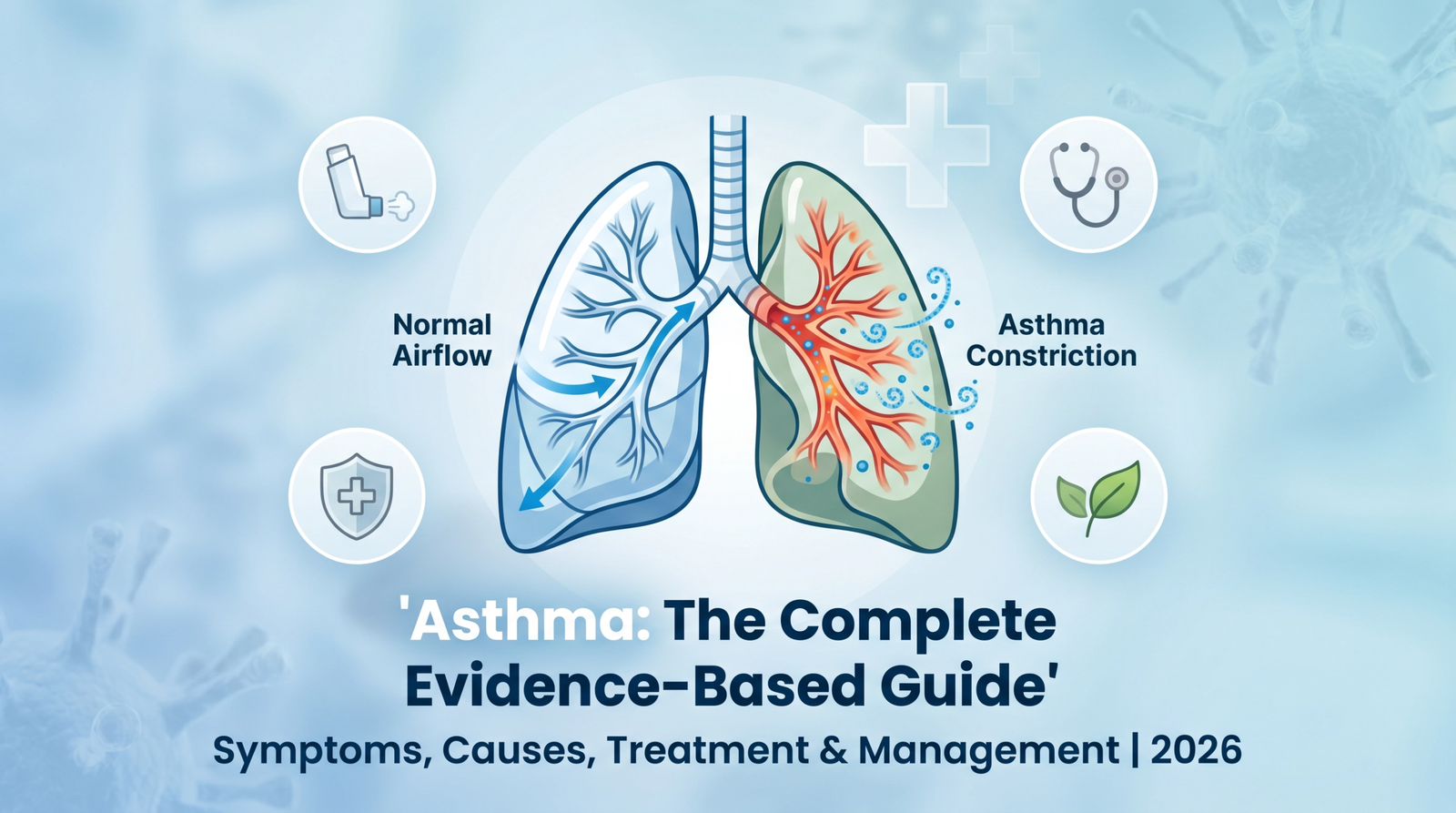
Asthma is a chronic inflammatory respiratory condition characterized by variable and recurring symptoms, reversible airflow obstruction, and bronchial hyperresponsiveness. The condition involves inflammatory cells — mast cells, eosinophils, T-lymphocytes — and structural airway cells.
Recognizing Asthma Symptoms
The Four Cardinal Symptoms
Wheezing: A high-pitched whistling sound during exhalation.
Shortness of breath: Difficulty breathing, worse at night or with exercise.
Chest tightness: Pressing sensation “like a band tightening around the ribs.”
Cough: Often dry, worse at night or with cold air.
Types and Clinical Phenotypes
- Allergic (Atopic) Asthma: Most common, triggered by allergens, IgE-mediated.
- Non-Allergic Asthma: Triggered by stress, cold air, viruses.
- Exercise-Induced Bronchoconstriction: Occurs during physical activity.
- Occupational Asthma: Caused by workplace exposures.
- Severe Asthma: Uncontrolled despite high-dose therapy; may require biologics.
Common Asthma Triggers
| Trigger Category | Examples | Avoidance Strategy |
|---|---|---|
| Allergens | Dust mites, pollen, pet dander, mold | HEPA filters, allergen-impermeable bedding |
| Irritants | Tobacco smoke, perfumes, cleaning chemicals | Smoke-free home, fragrance-free products |
| Weather | Cold dry air, thunderstorms | Scarf over mouth, indoor exercise |
| Infections | Rhinovirus, RSV, influenza | Annual flu vaccine, hand hygiene |
How Asthma Is Diagnosed
Spirometry is the gold standard: FEV1/FVC ratio below lower limit of normal indicates obstruction, with ≥12% improvement after bronchodilator supporting asthma. FeNO testing measures eosinophilic inflammation (adults: >25 ppb; children: >35 ppb). Peak flow monitoring helps track diurnal variability (>20% suggests asthma).
Asthma Treatment: Stepwise Approach (GINA 2023/2024)
Step 1: For patients with infrequent symptoms (≤2 times per month) AND no risk factors for exacerbations — as-needed low-dose ICS-formoterol may be appropriate. For others, daily low-dose ICS is preferred.
Steps 2-5: Daily controller therapy with ICS, add LABA, LAMA, or biologics as needed.
🫁 Take Control of Your Asthma Today
Discover expert-recommended asthma management programs and personalized action plans.
📢 Ad Explore Asthma Management Solutions →Biologic Therapies for Severe Asthma
| Biologic | Target | Dosing |
|---|---|---|
| Omalizumab (Xolair) | IgE | Subcutaneous every 2-4 weeks |
| Mepolizumab (Nucala) | IL-5 | 100 mg SC every 4 weeks |
| Benralizumab (Fasenra) | IL-5R | 30 mg SC every 4 weeks x3, then every 8 weeks |
| Dupilumab (Dupixent) | IL-4Rα | 200-300 mg SC every 2 weeks |
| Tezepelumab (Tezspire) | TSLP | 210 mg SC every 4 weeks |
Asthma: Myth vs. Fact
| ❌ MYTH | Asthma is just anxiety — it’s all in your head. |
| ✅ FACT | Asthma is a physical disease with measurable airway inflammation, bronchoconstriction, and mucus hypersecretion. Anxiety can worsen symptoms but does not cause asthma. |
| ❌ MYTH | People with asthma shouldn’t exercise. |
| ✅ FACT | With proper treatment, most people with asthma can exercise normally — many Olympic athletes have asthma. |
| ❌ MYTH | Inhaled steroids are dangerous and should be avoided. |
| ✅ FACT | ICS are very safe at prescribed doses and are the most effective controller medications. The benefits far outweigh minimal risks. |
🏆 Editor’s Choice: Top Asthma Management Resources Sponsored
Our respiratory specialists evaluated dozens of programs. These are the top recommendations for 2026.
| Rank | Resource | Rating | |
|---|---|---|---|
| #1 Top Pick | Comprehensive Asthma Control Program Complete management system with action plans | ★★★★★ 4.9/5 | Ad Learn More → |
| #2 | Advanced Breathing & Lung Health System | ★★★★★ 4.8/5 | Ad Learn More → |
| #3 | Digital Peak Flow Tracker | ★★★★☆ 4.6/5 | Ad Learn More → |
Sponsored content. We may earn commissions on purchases at no cost to you.
🎯 Asthma Control Test (ACT)
Answer these 5 validated questions to assess your asthma control over the past 4 weeks.
Create Your Personal Asthma Action Plan
📝 Interactive Action Plan Builder
Frequently Asked Questions
Some children experience remission during adolescence, but airway hyperresponsiveness often persists. Adult-onset asthma rarely remits.
Ad Explore long-term monitoring programs →Absolutely. With proper management, most can exercise normally. Use pre-exercise bronchodilator if prescribed, warm up gradually, and choose activities like swimming.
Ad Athlete’s guide to exercising with asthma →Yes — at prescribed doses, ICS are very safe. Benefits far outweigh minimal risks. Use a spacer and rinse mouth to prevent thrush.
Empowering Your Asthma Journey
Asthma is among the most controllable of all chronic diseases. With the right treatment, monitoring, and support, the vast majority of people can achieve complete symptom control and live active lives. If you are experiencing frequent symptoms, nighttime awakenings, or using your rescue inhaler more than twice weekly, your asthma is not well controlled — and your treatment needs adjustment. Don’t accept “good enough” when excellence is achievable.
📚 References
- Global Initiative for Asthma (GINA). Global Strategy for Asthma Management and Prevention, 2023/2024 Update.
- World Health Organization. Asthma Fact Sheet. 2026.
- National Asthma Education and Prevention Program. Guidelines (EPR-4), 2020.
- GBD 2023 Collaborators. Global asthma burden estimates. Lancet, 2025.
Leave a Reply