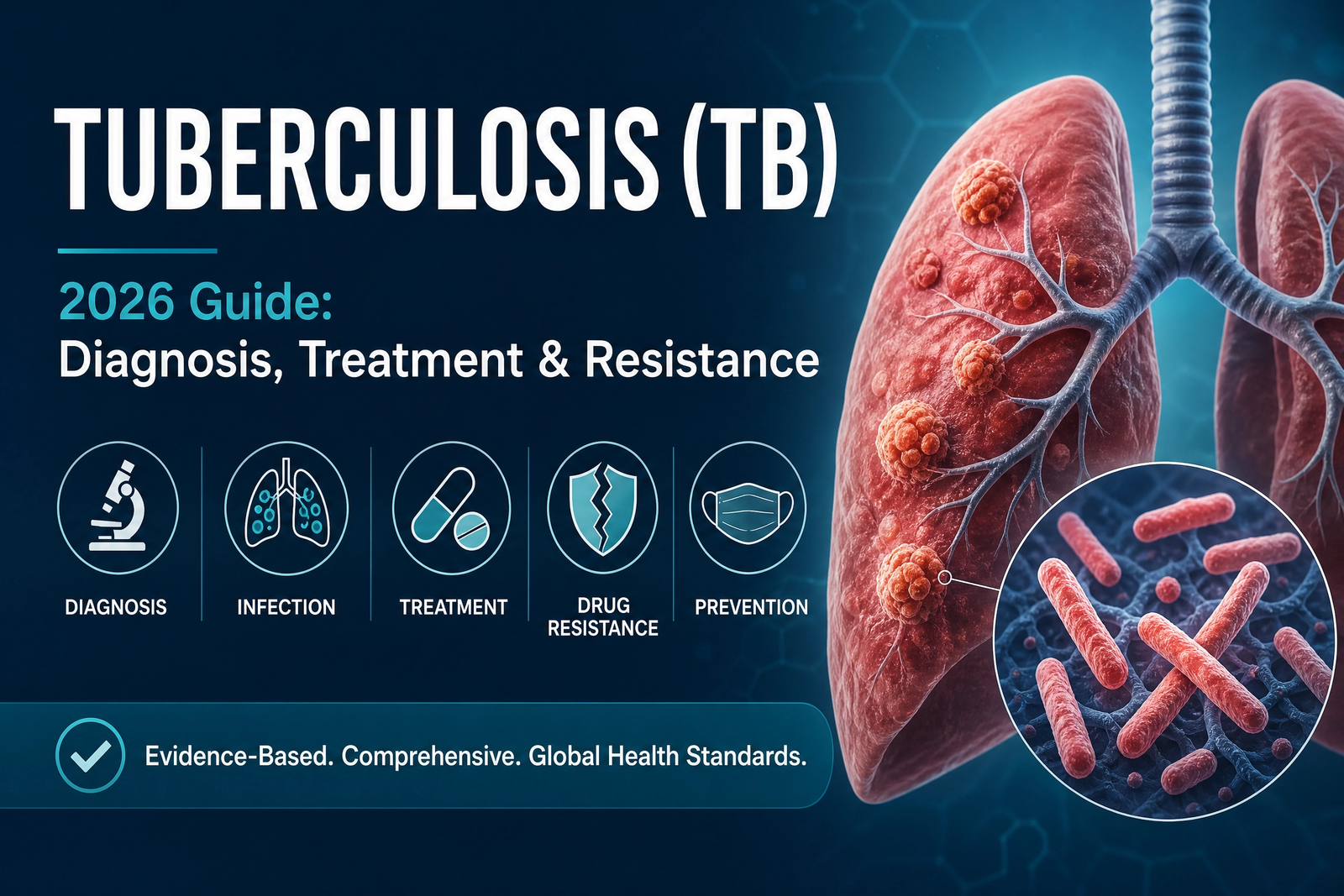
Tuberculosis (TB): Pathophysiology, Diagnosis, Treatment, and Drug Resistance
A comprehensive, peer-reviewed clinical resource on pulmonary tuberculosis — from transmission and pathogenesis to multidrug resistance and global control
I. Tuberculosis: Global Burden and Clinical Significance
Tuberculosis (TB) is an airborne infectious disease caused by Mycobacterium tuberculosis that remains the leading cause of infectious disease mortality worldwide, surpassing HIV/AIDS. In 2025, the World Health Organization estimated 10.6 million new TB cases and 1.3 million deaths globally, with 95% of cases occurring in low- and middle-income countries. Despite being preventable and curable, TB continues to exact a devastating toll, particularly in sub-Saharan Africa, Southeast Asia, and the Western Pacific regions.
Historically known as “consumption” for its characteristic wasting syndrome, TB has plagued humanity for millennia. The causative organism was identified by Robert Koch in 1882, and effective treatment was developed in the mid-twentieth century.
• 10.6 million new cases globally
• 1.3 million deaths (leading infectious cause)
• 500,000 MDR-TB cases annually
• 95% of cases in low/middle-income countries
• 30% of global cases in India, Indonesia, China, Philippines, Pakistan
• 8% of global cases are MDR-TB
HIV is the strongest risk factor for progression from latent TB to active disease. Approximately 10% of all new TB cases occur in people living with HIV, and TB accounts for 30-40% of HIV-related deaths. Early antiretroviral therapy (ART) and TB preventive therapy (TPT) are essential interventions in HIV-TB co-infected patients.
II. Pathogenesis of Tuberculosis
Transmission: M. tuberculosis is transmitted through airborne droplet nuclei (1-5 µm diameter) produced when an infectious patient coughs, sneezes, speaks, or sings. These particles can remain suspended in the air for hours, creating risk in poorly ventilated, crowded settings. Prolonged exposure in close contact is typically required for transmission, though occasional casual transmission has been documented.
Primary infection: When inhaled, droplet nuclei deposit in the alveolar spaces, where they are phagocytosed by alveolar macrophages. M. tuberculosis has evolved mechanisms to survive within macrophages, including inhibition of phagolysosome fusion and expression of virulence factors such as ESAT-6 and CFP-10. The bacteria replicate within macrophages over 2-12 weeks, eventually causing macrophage lysis and release of bacteria, which spreads to regional lymph nodes and throughout the bloodstream.
Granuloma formation and containment: The host immune response — primarily Th1 CD4+ T-cells producing interferon-gamma (IFN-γ) — initiates granuloma formation around infected macrophages. In immunocompetent individuals, the granuloma contains the infection, preventing further dissemination. This establishes a state of latent TB infection (LTBI). Granulomas may contain viable bacteria for decades, maintaining a reservoir for potential reactivation.
Progression to active disease: Reactivation occurs when granuloma integrity is compromised by immunosuppression (HIV, TNF-α inhibitors, corticosteroids, aging, malnutrition). Bacteria replicate within the granuloma, leading to central necrosis and cavity formation. Cavitation — the hallmark of active pulmonary TB — creates large, hypoxic microenvironments conducive to bacterial growth and transmission to the environment through cough.
III. Latent vs. Active Tuberculosis
| Feature | Latent TB (LTBI) | Active TB |
|---|---|---|
| Symptoms | None | Chronic cough, fever, night sweats, weight loss, hemoptysis |
| Contagious | No | Yes (until treatment response) |
| Chest Imaging | Normal or calcified granuloma | Infiltration, cavitation, hilar lymphadenopathy |
| TST/IGRA | Positive | Positive |
| Sputum Smear/Culture | Negative | Positive |
| Risk of Progression | 5-10% lifetime (higher if immunocompromised) | N/A (already active) |
| Treatment | 4-9 months (isoniazid ± rifapentine) | 6 months (RIPE regimen) |
LTBI treatment indications: Treatment is recommended for individuals at high risk of progression to active disease: HIV-positive individuals, close contacts of active TB cases, immunocompromised patients (TNF-α inhibitors, solid organ transplant, chronic steroids), individuals with recent TST/IGRA conversion, and persons with fibrotic changes on CXR consistent with healed TB.
IV. Clinical Presentation of Pulmonary Tuberculosis
Classic Symptoms of Active TB
- Chronic cough (present in 90%): Initially dry, then productive with mucoid or purulent sputum; duration >3 weeks is a classic red flag.
- Hemoptysis (30-50%): Coughing up blood due to erosion of blood vessels in cavitary lesions; may range from blood-streaked sputum to massive hemoptysis.
- Fever and night sweats (60-80%): Low-grade afternoon fevers (37.5-38.5°C) with nightly drenching sweats requiring change of bedding.
- Unintentional weight loss (50-70%): Anorexia and hypermetabolic state cause significant weight loss; often described by patients as “feeling like I’m wasting away.”
- Fatigue and malaise: Profound weakness, often disproportionate to physical exertion, due to systemic inflammation.
- Chest pain (40-60%): Pleuritic pain from pleural involvement; less common in simple pulmonary TB.
- Dyspnea on exertion: Progressive shortness of breath from parenchymal destruction and ventilation-perfusion mismatch.
Atypical Presentations
In elderly patients, the elderly often present with subtle symptoms: weight loss, confusion, failure to thrive without fever or cough. In immunocompromised patients (HIV), they often present with extrapulmonary TB, disseminated disease, or atypical CXR findings (absence of cavitation, diffuse infiltrates) and negative smear results (paucibacillary disease).
• Cough >3 weeks with any of: weight loss, fever, night sweats, or hemoptysis
• Unexplained weight loss >5% body weight in 3 months
• Abnormal CXR with upper lobe infiltrates, cavities, or hilar adenopathy
• Known exposure to active TB case
• History of immunosuppression (HIV, TNF-α inhibitors, transplant)
V. Diagnostic Approach to Tuberculosis
Sputum Smear Microscopy (Acid-Fast Bacilli)
Direct microscopy of concentrated sputum specimens stained with Ziehl-Neelsen (carbol fuchsin) or auramine-rhodamine (fluorescent) stains reveals acid-fast bacilli (AFB). Sensitivity is 50-70% for smear-positive cases; sensitivity declines to 30-50% in HIV co-infection. Positive AFB smear is suggestive but not definitive of M. tuberculosis; NTM can also be AFB-positive.
Culture — The Gold Standard
Culture confirms the diagnosis and provides material for drug susceptibility testing (DST). Solid media (Lowenstein-Jensen) takes 4-8 weeks; liquid media (BACTEC MGIT) reduces time to 1-3 weeks. Culture is positive in 80-90% of pulmonary TB cases but requires appropriate specimen collection.
Molecular Testing — GeneXpert MTB/RIF
GeneXpert is a rapid molecular test that detects M. tuberculosis DNA and rifampin resistance (a surrogate marker for MDR-TB) in less than 2 hours. Sensitivity is 90-95% for smear-positive and 70-80% for smear-negative cases. It is recommended as the initial test for TB in high-burden settings and in patients with symptoms suggestive of TB.
Chest Radiography
Classic CXR findings include upper lobe infiltrates (80% of cases), cavitation (30-50%), fibrotic changes, hilar or mediastinal lymphadenopathy (especially in children and HIV patients), miliary pattern (miliary TB), and pleural effusion (10-20%). In immunocompromised patients, CXR may show unusual patterns: lower/mid-zone infiltrates, diffuse reticulonodular opacities, or miliary pattern.
Tuberculin Skin Test (TST) and Interferon-Gamma Release Assays (IGRAs)
TST measures delayed-type hypersensitivity to PPD (purified protein derivative). A positive TST indicates prior infection (LTBI or active TB). Interpretation depends on induration size and risk factors. IGRAs (QuantiFERON-TB Gold Plus, T-SPOT.TB) measure IFN-γ release in response to TB-specific antigens (ESAT-6, CFP-10). IGRAs are more specific than TST (less cross-reaction with BCG and NTM) but cannot differentiate LTBI from active TB. Both tests are diagnostic for LTBI, not for active TB.
1. Clinical suspicion (cough >3 weeks + risk factors) → CXR + sputum AFB microscopy
2. If CXR abnormal or AFB positive → GeneXpert MTB/RIF (same-day)
3. If GeneXpert positive for M. tuberculosis → initiate treatment
4. If GeneXpert negative but suspicion high → culture + DST
5. If culture confirmed → phenotypic DST and treatment adjustment
VI. Treatment Protocols for Drug-Susceptible TB
First-Line Regimen (RIPE)
Intensive phase (2 months):
• Isoniazid (H) 5 mg/kg (max 300 mg) daily
• Rifampin (R) 10 mg/kg (max 600 mg) daily
• Pyrazinamide (Z) 25 mg/kg (max 2,000 mg) daily
• Ethambutol (E) 15-20 mg/kg (max 1,600 mg) daily
Continuation phase (4 months):
• Isoniazid (H) + Rifampin (R) daily
Total duration: 6 months (2HRZE + 4HR). DOT (directly observed therapy) is recommended to ensure adherence and prevent acquired drug resistance. Treatment extension to 9-12 months is indicated for TB meningitis, bone/joint TB, or patients who remain culture-positive at 2 months.
Drug Monitoring and Side Effects
Isoniazid: Peripheral neuropathy (pyridoxine 25-50 mg daily for prevention), hepatotoxicity (monitor LFTs), rash, drug interactions (inhibits CYP450).
Rifampin: Hepatotoxicity, orange discoloration of body fluids, drug interactions (potent CYP450 inducer, affects oral contraceptives, warfarin, antiretrovirals).
Pyrazinamide: Hepatotoxicity, hyperuricemia (gout), arthralgias (management with NSAIDs), GI intolerance.
Ethambutol: Optic neuritis (reduced red-green color vision, visual acuity), dose-dependent; usually reversible if detected early. Monthly visual acuity and color vision testing is recommended.
VII. Drug-Resistant Tuberculosis: MDR-TB and XDR-TB
Multidrug-resistant TB (MDR-TB): Resistant to at least isoniazid and rifampin. Risk factors include prior TB treatment, inadequate therapy, DOT failure, exposure to MDR-TB cases, and acquired resistance through poor adherence.
Extensively drug-resistant TB (XDR-TB): Resistant to isoniazid, rifampin, any fluoroquinolone, and at least one of three injectable second-line drugs (amikacin, kanamycin, capreomycin).
Treatment of MDR-TB: WHO recommends a 6-9 month “short-course” regimen for MDR-TB (bedaquiline, pretomanid, linezolid, moxifloxacin) — the BPaLM regimen — for patients without resistance to these drugs. For patients with resistance or severe disease, a longer regimen (18-24 months) with individualized treatment is required. Surgery may be indicated for localized MDR-TB with limited drug options.
VIII. Prevention and BCG Vaccination
BCG (Bacille Calmette-Guérin) vaccine: A live attenuated vaccine derived from M. bovis. Protection against pulmonary TB in adults is variable (0-80%). BCG is recommended at birth in high-burden countries but is not routinely used in the United States due to low TB incidence and interference with TST interpretation. BCG is contraindicated in immunocompromised individuals (including HIV infection).
TB Preventive Therapy (TPT): LTBI treatment regimens: isoniazid 300 mg daily for 6-9 months, rifampin 600 mg daily for 4 months, rifapentine + isoniazid weekly for 3 months (3HP), isoniazid + rifapentine for 1 month (1HP, preferred for HIV-positive patients).
• Airborne infection isolation rooms (AIIR) with negative pressure
• N95 respirators or higher (HEPA-filtered PAPR) for staff
• UVGI (ultraviolet germicidal irradiation) for upper-room air disinfection
• Respiratory hygiene (masking for patients)
• Staff testing (TST/IGRA) upon hire and annually
IX. Interactive Clinical Tools
🫁 Tuberculosis Symptom and Risk Assessment Quiz
This validated screening tool evaluates TB risk based on symptoms, exposure, and risk factors.
X. Frequently Asked Questions
Tuberculosis (TB) is a bacterial infection caused by Mycobacterium tuberculosis. It primarily affects the lungs (pulmonary TB) but can affect any organ. TB is transmitted through airborne droplets when an infected person coughs, sneezes, or speaks. It remains a leading cause of infectious disease mortality worldwide.
Latent TB (LTBI) is a state where a person is infected with M. tuberculosis but has no symptoms, is not contagious, and has normal chest imaging. Active TB is symptomatic, contagious, and has radiographic abnormalities. Treatment is recommended for LTBI to prevent progression to active disease, especially in immunocompromised individuals.
First-line treatment consists of a 6-month regimen: 2 months of isoniazid, rifampin, pyrazinamide, and ethambutol (RIPE), followed by 4 months of isoniazid and rifampin. Directly observed therapy (DOT) is recommended to ensure adherence. Treatment extension to 9-12 months is recommended for TB meningitis and bone/joint TB.
MDR-TB is resistant to at least isoniazid and rifampin. XDR-TB is resistant to isoniazid, rifampin, any fluoroquinolone, and at least one injectable second-line drug. Treatment requires longer courses (18-24 months) with second-line agents and has higher mortality.
Diagnosis requires demonstration of M. tuberculosis from clinical specimens. Methods include sputum smear microscopy (AFB), culture (gold standard), molecular tests (GeneXpert MTB/RIF), and chest imaging. TST and IGRAs are used for LTBI diagnosis.
The BCG vaccine is a live attenuated vaccine used for TB prevention. Protection against pulmonary TB in adults is variable. It is recommended in high-burden countries but not routinely used in the United States.
Classic symptoms include chronic cough (>3 weeks), hemoptysis, fever (often evening fevers), night sweats, unintended weight loss, fatigue, and chest pain. Some patients present with asymptomatic pulmonary TB diagnosed incidentally on imaging. Extrapulmonary TB symptoms depend on the organ involved.
Yes, drug-susceptible pulmonary TB is curable with a 6-month course of first-line antibiotics.
Sources and further reading
- Tuberculosis (TB) – NHS
- tuberculosis – MedlinePlus (NIH)
- NICE NG33: Tuberculosis
- Tuberculosis – WHO fact sheet
This article is general information and not a substitute for professional medical advice.
Leave a Reply