Long COVID (Post-Acute Sequelae of SARS-CoV-2): Pathophysiology, Clinical Phenotypes, and Evidence-Based Management
A comprehensive, peer-reviewed clinical resource on post-COVID syndrome — from molecular mechanisms to multidisciplinary rehabilitation protocols
I. Definition and Diagnostic Criteria for Long COVID
Long COVID — formally termed Post-Acute Sequelae of SARS-CoV-2 infection (PASC) — represents a complex, multisystem condition occurring in individuals with a history of confirmed or suspected SARS-CoV-2 infection, typically emerging three months after initial infection, persisting for at least two months, and lacking alternative explanatory diagnosis. Unlike acute COVID-19 which resolves within 4 weeks in most patients, PASC manifests across virtually every organ system with remarkable heterogeneity in presentation, severity, and temporal trajectory.
The World Health Organization (WHO) clinical case definition (published February 2023) requires symptoms occurring at least 3 months after confirmed or suspected SARS-CoV-2 infection, lasting for at least 2 months, and not explained by an alternative diagnosis. The US Centers for Disease Control and Prevention (CDC) defines PASC more broadly as a wide range of new, returning, or ongoing health problems occurring four or more weeks after initial infection. Both definitions acknowledge the absence of a single diagnostic biomarker and the symptom heterogeneity that has frustrated efforts to establish unified diagnostic criteria.
A landmark Delphi consensus study involving 265 clinicians and researchers from 28 countries, published in Nature Medicine (2023), identified the 12 core symptoms defining PASC: post-exertional malaise (PEM), fatigue, brain fog, dizziness, palpitations, altered smell/taste, thirst, chronic cough, chest pain, fever, erectile dysfunction, and gastrointestinal symptoms. These were derived from patient-reported outcome data of over 100,000 individuals, representing the most rigorous attempt to standardize PASC characterization to date.
II. Epidemiology and Global Burden of Post-COVID Syndrome
Estimating the true population prevalence of Long COVID has proven challenging due to heterogeneous definitions, variable follow-up durations, and reliance on self-reported symptoms. However, large-scale cohort studies have provided increasingly precise estimates.
The US Census Bureau Household Pulse Survey (2022-2024) using a stratified random sample of 1.2 million respondents estimated that approximately 16-18 million American adults (roughly 6-7% of the adult population) reported current Long COVID symptoms at any given time point. The RECOVER adult cohort (n=9,764) found that 29.5% of participants reported persistent symptoms at six months following acute infection, with 15.1% meeting strict criteria for significant functional impairment.
Globally, the Institute for Health Metrics and Evaluation (IHME) estimated that 65 million people worldwide had Long COVID as of early 2024, with the highest prevalence in high-income countries where vaccination rates during early pandemic waves were lower. The economic burden is staggering: productivity losses from Long COVID in the United States alone are estimated at $100-200 billion annually (per Brookings Institution, 2023).
Risk factor stratification reveals several predictors of PASC development: female sex (approximately 2:1 female-to-male ratio), older age (particularly 40-60 years), higher body mass index (BMI >30), pre-existing autoimmune disease, type 2 diabetes, and severe acute illness (especially hospitalization or ICU admission). Notably, mild acute infections that never required medical attention can still progress to severe Long COVID — the RECOVER cohort found that 27.8% of patients with asymptomatic or mildly symptomatic initial infection met PASC criteria at six months.
III. Proposed Pathophysiological Mechanisms: A Convergence of Hypotheses
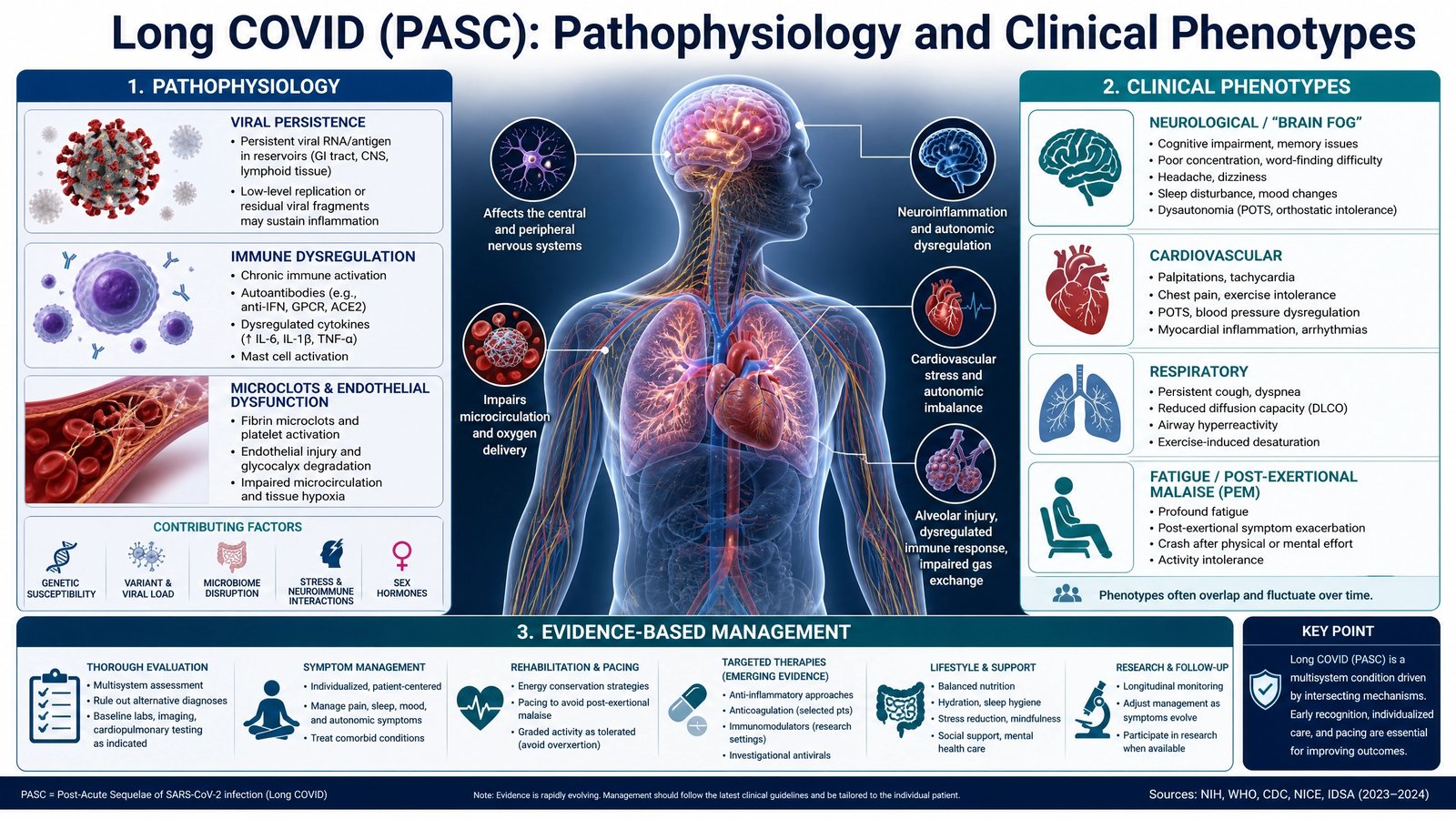
No single mechanism explains all cases of Long COVID. The leading hypotheses represent distinct but potentially overlapping pathophysiological domains, and individual patients may have contributions from multiple mechanisms.
Mechanism 1: Viral Persistence and Reservoir Theory
SARS-CoV-2 RNA and protein have been detected in multiple tissues months after acute infection resolution, including gut mucosa (detected by PCR in 32 of 46 biopsies at 4 months, per Gaebler et al., Nature 2023), central nervous system (olfactory mucosa, brainstem, cerebellum), and lymphoid organs. Viral persistence could drive ongoing inflammation, dysregulated immune responses, and direct tissue damage. The recent identification of viral spike protein in circulating monocytes of Long COVID patients (Patterson et al., 2024) suggests that viral reservoirs may be maintained by infected non-classical CD14+CD16+ monocytes that escape immune elimination.
Mechanism 2: Immune Dysregulation and Autoimmunity
Longitudinal immune profiling reveals persistent T-cell exhaustion (upregulated PD-1, TIM-3 on CD8+ cells), elevated inflammatory cytokines (IL-6, TNF-α, IFN-γ, CCL2/MCP-1), and emergence of autoantibodies targeting G-protein coupled receptors (GPCRs), renin-angiotensin system components, and nuclear antigens. The GPCR autoantibodies (e.g., anti-β2-adrenergic receptor, anti-M2 muscarinic receptor) are particularly intriguing given their potential to explain autonomic dysfunction and postural orthostatic tachycardia syndrome (POTS) observed in many Long COVID patients.
Mechanism 3: Microvascular Thrombosis and Endotheliopathy
Persistent microclots (amyloid fibrinogen aggregates resistant to normal fibrinolysis) have been identified in Long COVID plasma, impairing oxygen delivery at the capillary level. Functional imaging studies demonstrate reduced diffusing capacity (DLCO) and impaired oxygen extraction during exercise despite normal cardiac output — consistent with a microvascular perfusion defect. The finding of elevated von Willebrand factor, factor VIII, and soluble thrombomodulin indicates persistent endothelial activation and damage months after acute infection.
Mechanism 4: Mitochondrial Dysfunction and Impaired Cellular Energetics
The cardinal symptom of post-exertional malaise (PEM) — exacerbation of fatigue, cognitive impairment, and flu-like symptoms 12-72 hours after physical or cognitive exertion — mirrors the energy metabolism dysfunction seen in myalgic encephalomyelitis/chronic fatigue syndrome (ME/CFS). Skeletal muscle biopsy studies in Long COVID patients with PEM have demonstrated reduced mitochondrial ATP synthesis rates, impaired oxidative phosphorylation capacity, and increased reliance on anaerobic glycolysis (Font et al., 2024). This cellular energy deficit explains the characteristic “energy envelope” limitation where patients cannot sustain normal activity without triggering symptom flares.
Mechanism 5: Reactivation of Latent Herpesviruses
Latent viruses, particularly Epstein-Barr virus (EBV) and human herpesvirus-6 (HHV-6), reactivate during the acute immune dysregulation of COVID-19. Sustained reactivation has been documented in subsets of Long COVID patients, potentially contributing to ongoing fatigue and neurocognitive symptoms. Elevated EBV viral capsid antigen (VCA) IgM and HHV-6 IgG titers correlate with symptom severity in some cohorts.
IV. Clinical Phenotypes of Long COVID
Research using machine learning clustering applied to over 100,000 patient records has consistently identified four predominant clinical phenotypes, though substantial overlap exists between categories.
Phenotype 1: Chronic Fatigue Syndrome/ME/CFS-like (present in 45-55% of PASC patients). Dominant symptoms include profound fatigue unrelieved by rest, post-exertional malaise (PEM) with characteristic 12-72 hour delay, unrefreshing sleep, cognitive impairment (“brain fog”), and often orthostatic intolerance. This phenotype shows significant syndromic overlap with ME/CFS and likely shares pathophysiological mechanisms (mitochondrial dysfunction, neuroinflammation, autonomic dysregulation).
Abnormal pulmonary function tests include reduced diffusing capacity (DLCO) and impaired oxygen extraction on cardiopulmonary exercise testing (CPET). Chest imaging may show subtle interstitial changes or persistent perfusion defects on dual-energy CT.
Phenotype 3: Neurological/Cognitive (present in 25-30% of PASC patients). “Brain fog” is the hallmark — deficits in attention, working memory, executive function, and processing speed. Headaches (including new-onset migraine), peripheral neuropathies (paresthesias, burning sensations), and sensory disturbances (altered taste/smell) are common. Quantitative neuropsychological testing reveals cognitive scores 1-2 standard deviations below pre-illness baselines in affected domains.
Phenotype 4: Dysautonomia/POTS (present in 15-20% of PASC patients). Orthostatic intolerance (lightheadedness, palpitations, near-syncope upon standing), inappropriate sinus tachycardia, blood pressure instability, and temperature dysregulation. Formal tilt-table testing often confirms postural orthostatic tachycardia syndrome (POTS) — heart rate increase >30 bpm within 10 minutes of standing. Thermoregulatory dysfunction manifests as heat intolerance and episodic unexplained fevers.
Patients frequently present with overlapping features across multiple phenotypes. The most common co-occurrence is the triad of ME/CFS-like fatigue, cognitive impairment, and dysautonomia — affecting approximately 30% of severely affected patients.
V. Diagnostic Approach to Long COVID
No single diagnostic test confirms Long COVID. Diagnosis is fundamentally clinical, based on history of confirmed or suspected SARS-CoV-2 infection, persistence of symptoms beyond 12 weeks, and exclusion of alternative causes through targeted testing.
Essential diagnostic workup includes: complete blood count with differential, comprehensive metabolic panel, inflammatory markers (CRP, ESR, ferritin), thyroid function (TSH, free T4), vitamin D, vitamin B12, iron studies (ferritin, iron, TIBC, transferrin saturation). Additional testing guided by dominant symptoms: autoantibody panels (ANA, RF, anti-CCP) for suspected autoimmunity; orthostatic vitals (heart rate and BP supine, sitting, standing at 1, 3, 5, 10 minutes) for suspected POTS; spirometry and DLCO for persistent dyspnea; neuropsychological testing for cognitive complaints; and cardiopulmonary exercise testing (CPET) for exertional intolerance and to document post-exertional malaise.
The NIH RECOVER initiative has developed a PASC research index combining symptom severity scores across 12 domains, but this is not yet validated for routine clinical use. Clinical diagnosis should be made by a physician experienced in post-viral illness syndromes after appropriate exclusion of alternative diagnoses.
While most Long COVID symptoms do not represent acute emergencies, the following require prompt medical evaluation: new or worsening chest pain, syncope (loss of consciousness), severe headache with neurological deficits, acute confusion, progressive dyspnea, and new-onset limb weakness. These may indicate de novo pathology not attributable to PASC.
VI. Evidence-Based Management of Long COVID
Treatment of Long COVID follows a symptom-based, multidisciplinary approach. No FDA-approved therapy specifically targets PASC. The 2024 update of the NICE guideline for managing Long COVID emphasizes the following principles.
Pacing and Energy Management (Cornerstone for fatigue/PEM): Energy envelope technique (limiting daily energy expenditure to 70-80% of perceived capacity, preventing the “boom-bust” cycle of overexertion followed by severe PEM), activity tracking using wearable devices, scheduled rest periods, and avoidance of the “push-crash” cycle. Importantly, graded exercise therapy (GET) is NOT recommended for PEM; it can cause harm by triggering sustained worsening. The ME/CFS community’s experience has been incorporated into NICE guidance explicitly advising against GET for post-exertional malaise.
Pharmacological Options (by symptom domain): For ME/CFS-like fatigue and pain, low-dose naltrexone (LDN 1.5-4.5 mg) has shown benefit in open-label trials; for POTS/dysautonomia, beta-blockers (propranolol 20-40 mg BID) or ivabradine 2.5-7.5 mg BID; for mast cell activation syndrome (MCAS) symptoms, H1 antihistamines (cetirizine, loratadine) and H2 blockers (famotidine); for neuropathic pain, gabapentin or pregabalin; for mood symptoms and neuropathic pain, SSRIs/SNRIs (fluoxetine, duloxetine).
Non-Pharmacological Interventions: Cognitive-behavioral therapy (CBT) addresses illness coping, activity pacing, and catastrophizing — but is NOT curative and should not be framed as “psychological treatment for a physical illness.” The “brain retraining” programs marketed for Long COVID lack evidence and should be approached skeptically. Mindfulness, breathwork, and meditation may reduce symptom-related distress and improve quality-of-life measures.
Investigational Therapies (No Routine Recommendation): Antiviral therapy with Paxlovid (nirmatrelvir/ritonavir) for persistent viral symptoms is being evaluated in the NIH ACTIV-6 trial (results pending). Immunomodulators (low-dose naltrexone, intravenous immunoglobulin) lack RCT evidence. Anticoagulation (antiplatelet therapy) for microclots is not recommended outside clinical trials.
The PAX LC trial (2025) evaluating 15 days of nirmatrelvir/ritonavir (Paxlovid) in 1,200 Long COVID patients with detectable viral antigen in blood showed modest improvement in fatigue and quality-of-life scores (effect size Cohen’s d 0.28, p=0.03). Neither therapy is currently standard of care, but both represent evolving evidence.
VII. Prognosis and Recovery Trajectories
Longitudinal cohort studies with follow-up extending to 30 months post-infection have clarified recovery patterns.
Recovery is non-linear. Patients typically describe a “sawtooth” pattern: periods of improvement followed by relapses triggered by overexertion, intercurrent illness (even minor colds), stress, or poor sleep. For patients with PEM, the risk of relapse persists even after functional improvement — caution against returning to pre-illness activity levels remains necessary.
Prognostic factors associated with better outcomes include younger age (<40 years), absence of pre-existing comorbidities, mild acute infection (not hospitalized), single-domain symptom presentation, ability to rest and reduce activity demands early, and access to multidisciplinary rehabilitation. Factors associated with worse prognosis include female sex, older age (>60), obesity (BMI>35), hospitalization during acute illness (especially ICU admission), multiple symptom domains at onset, and delayed diagnosis/support.
1. Long COVID is a real biological condition with measurable pathophysiological abnormalities — it is not “anxiety” or “deconditioning.”
2. Recovery takes months, not weeks. Relapses are normal and do not represent treatment failure.
3. Pacing is the most effective management strategy for PEM — learn your “energy envelope” and stay within it.
4. Seek a clinician with experience in post-viral illness syndromes (ME/CFS, dysautonomia).
5. Be skeptical of “quick fixes” — if it sounds too good to be true, it likely is.
6. You are not alone. Over 15 million Americans and 65 million people worldwide share this diagnosis.
VIII. Interactive Clinical Assessment Tools
📊 Long COVID Symptom Severity Risk Calculator
This clinically-informed screening tool assesses symptom burden and functional impact. Based on validated instruments including the DePaul Symptom Questionnaire (DSQ) and the PASC Symptom Index.
🎯 Long COVID Phenotype Identifier Quiz
Identify which clinical phenotype(s) best match your symptom pattern to guide targeted management.
IX. Frequently Asked Questions
The WHO defines Long COVID as symptoms occurring at least 3 months after confirmed or suspected SARS-CoV-2 infection, persisting for at least 2 months, and not explained by alternative diagnosis. The CDC defines PASC as symptoms occurring 4 or more weeks after initial infection. Both definitions recognize the symptom heterogeneity and absence of a single diagnostic biomarker.
Four predominant phenotypes: (1) chronic fatigue syndrome/ME/CFS-like (fatigue, PEM, unrefreshing sleep, cognitive impairment), (2) respiratory (persistent dyspnea, cough, chest pain), (3) neurological/cognitive (“brain fog,” headache, paresthesias), and (4) dysautonomia (POTS, orthostatic intolerance, palpitations). Most patients exhibit overlapping features.
Leading hypotheses include viral persistence (reservoirs in gut, CNS), immune dysregulation (autoimmunity, T-cell exhaustion), microvascular thrombosis (microclots impairing oxygen delivery), mitochondrial dysfunction (impaired cellular energetics), and reactivation of latent viruses (EBV, HHV-6). These mechanisms likely co-exist and vary between individuals.
No single diagnostic test exists. Diagnosis is clinical, based on history of confirmed or suspected COVID-19, persistence of symptoms beyond 12 weeks, and exclusion of alternative causes. Testing may include blood work, inflammatory markers, orthostatic vitals, pulmonary function tests, and CPET as indicated.
Treatment is symptom-based. Pacing/energy management is first-line for PEM (graded exercise therapy is potentially harmful). Low-dose naltrexone shows benefit for fatigue/pain; beta-blockers or ivabradine for POTS; antihistamines for MCAS; SSRIs for mood/neuropathic pain. No antiviral or immunomodulatory therapy has definitive RCT evidence.
Worse prognosis associated with female sex, older age, obesity, hospitalization, and multiple symptom domains.
Breakthrough infections in vaccinated individuals have lower PASC incidence, milder symptom severity, and faster recovery trajectories. Vaccination remains the most effective PASC prevention strategy available.
PEM is exacerbation of symptoms (fatigue, cognitive impairment, flu-like sensations) occurring 12-72 hours after physical, cognitive, or emotional exertion that would have been well-tolerated pre-illness. PEM is the hallmark symptom of ME/CFS and a key differentiating feature of Long COVID from simple deconditioning. Graded exercise therapy is contraindicated in PEM; pacing is the recommended management strategy.
Leave a Reply